Contextual Background
One of the most challenging processes to teach in printmaking is stone lithography. Its multiple steps, chemical principles and lengthy processing makes it hard for students to remember and for most technicians to teach.
Evaluation
Most students struggle to work fully independent. That is due to the amount of different chemicals and products needed, the multiple and repeated steps, and how nerve-racking the process can be, with little mistakes impacting greatly the final result. Thus, students constantly double-check with a technician before making any step, resulting in them not working confidently, and needing all the attention of technicians when processing their stone.
Moving forwards
Demystifying the Stone Through Examples
Taking advantage of the “embodied knowledge” (Orr S., Shreeve A., .2018) of physically engaging with materials, I see a need to re-codify the general perception of stone lithography. Not as a complicated, tedious process, but rather a craft that is only learnt thoroughly through first-hand experience: as William Morris remarked “to know a craft, you had to experience it with your own hands” (2018, p.102).
Understanding that there’s a learning curve is central to the persuasion of this process, not taking mistakes as failures, but as an opportunity to learn more from the reaction of the stone. Showing examples of prints and analysing when it doesn’t work and why it didn’t work, can liberate them from the pressure of getting it right from the start. That was the approach that I experienced when studying this craft at Tamarind Institute, a worldwide leading institution for stone lithographers.
Social Learning Environment
There are a number of aspects that could be improved to make the lithography section in the studio a better, more intuitive learning environment:
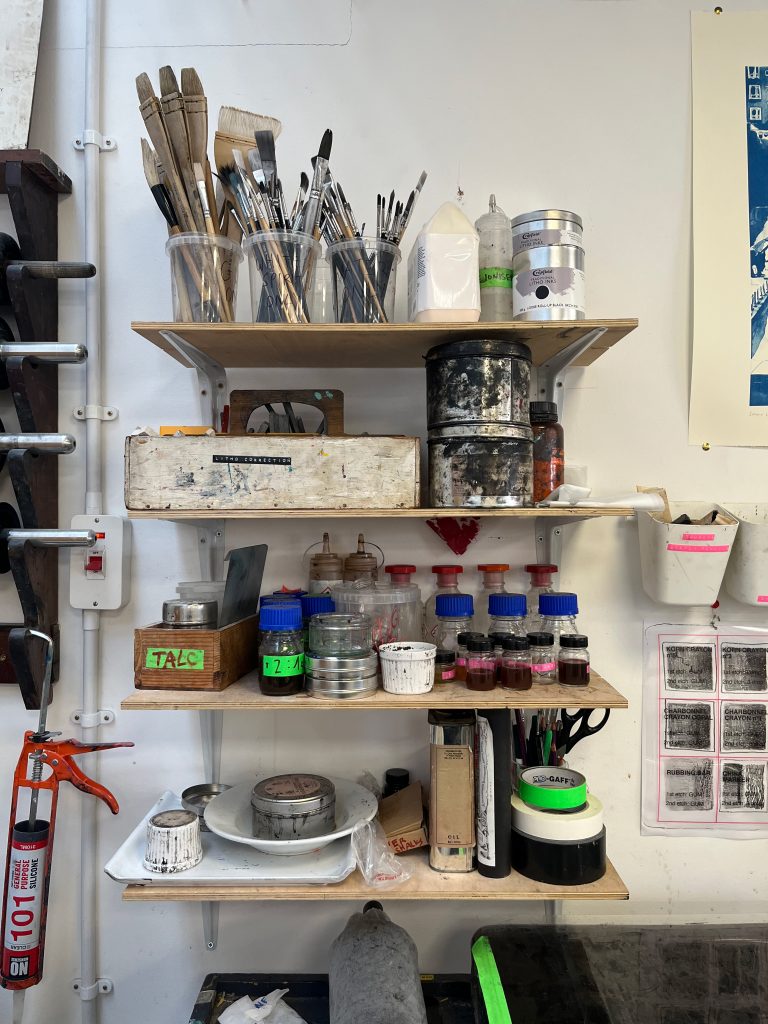
- Re-arrange the space: rearranging the stone lithography section in the studio to create a workflow route that can help to structure learning has also contributed to give students a sense of control over the process. For instance, labelling every single tool, product or sundry; organising sponges depending on their use; or compiling all materials on the same set of shelves to help them remember every step of that stage.
- Peer to peer support: as the workshop is a “social place where learning is visible and open to discussion” (Orr and Shreeve, 2017), I would like to incentivise an “active participation” (ibid) among students. My next step is to create a safe space for these discussions amongst peers to take place informally, showing my least successful prints as well as the fullest potential of the process and inviting them to do the same. Learning from other’s experience can make them less frighten to take initiative and come up with their own conclusions. Overcoming the technical insecurities of stone lithography, the conversation can shift towards progress and the work itself.
- Language of the Discipline: stone lithography is perceived as a very abstract process given its strong chemistry component. Developing a terminology common to all is key in defining such an abstract process as the “role of language in the learning process runs parallel to the visual and material world” (Orr, and Shreeve, 2018,). I am talking of terms that encompass a series of steps such as opening/ closing the stone, applying a loose gum, or tint field . Emphasising this particular language in inductions and in 1-2-1 support will provide a more solid frame for the student to work, and a sense of ownership of the process. In this regards, I developed a handout which was subject of evaluation in Review Teaching Practice 1.
References
Orr S., Shreeve A., . (2018). Art and design pedagogy in higher education. London: Routledge.
Orr & Shreeve, (2017) Signature Pedagogies in Art & Design. London.
Leave a Reply