Intersectionality Echos
Californian artist Christine Sun Kim describes her life as full of “echos”. She uses an interpreter to communicate with the “hearing world” as she describes it, which actively works as an echoing mechanism for her message to reach further.
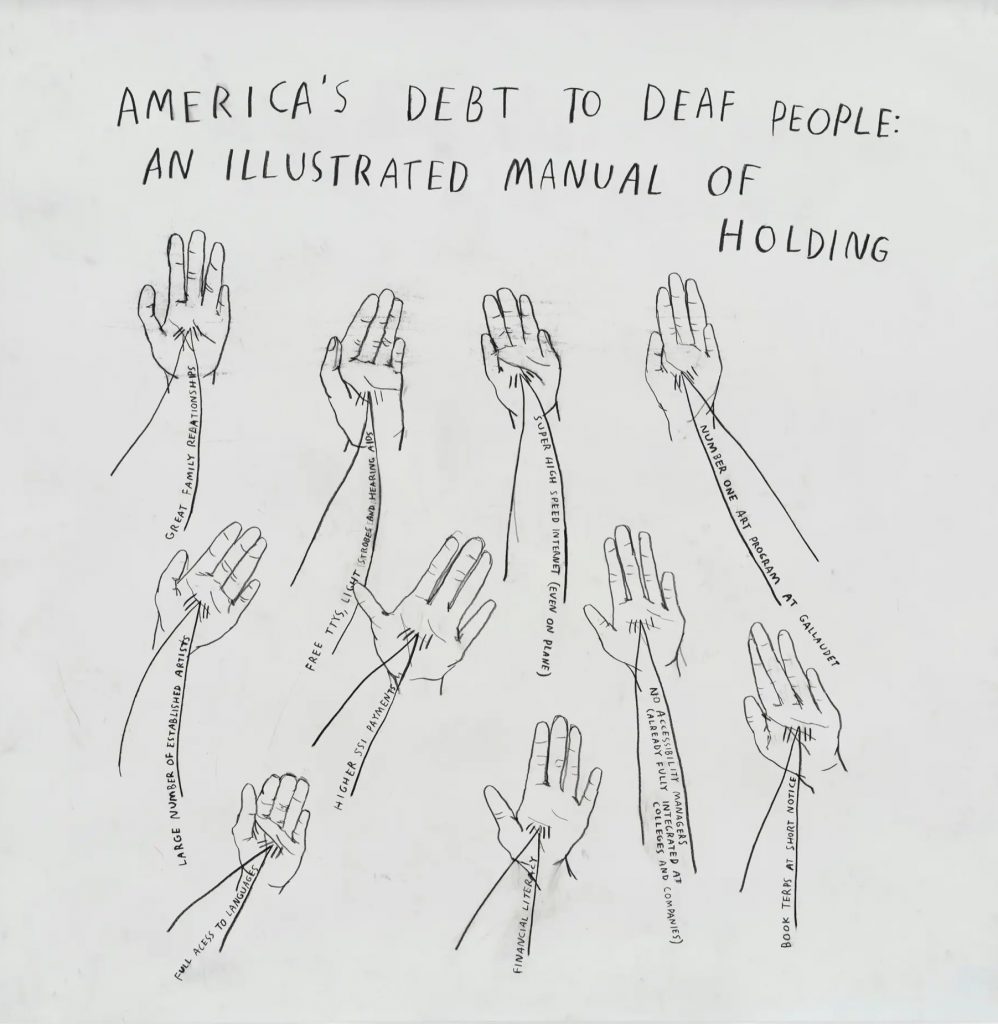
Her body of work also operates as an echo of her experience as deaf artist, using sign language and large format installations to communicate her ideas on socioeconomic inequality, and systemic discrimination towards those who do not represent conformity. As an artist who suffered these injustices during her journey, for instance, when she wanted to study art, but was denied it due to the lack of interpreters, she now uses her position to denounces discrimination and gatekeeping directed to disable people or stigmatised communities.
She is also a mother who allows her kid to participate of the creative process. Motherhood has historically impacted the artistic careers of female artists, who feel forced to interrupt their practice during the initial years of upbringing. Luckily, Sun Kim lives in Berlin, where the state subsidises childcare expenses, which, she acknowledges, would be unthinkable of in countries such her country of birth, USA.
Hence, her disability exists within overlapping systems of power. What makes intersectionality especially important is that it shifts attention away from individual prejudice alone and toward systems. In a way, intersectionality echos these injustices and amplifies the implications of certain identity conditions, such as gender, race, socioeconomic backgrounds, physical disabilities, neurodivergence, or motherhood.
In creative education institutions, as Sun Kim describes, as are often designed around narrow assumptions of who is considered productive, independent, or worthy. She could have given up her ambition to make art, because she couldn’t attend relevant classes. In other words, she was kept away from education because her disability was not even taken into account. Some other times discrimination happens due to unintentionally privilege confidence, verbal communication, speed, and independent working styles, which may disadvantage disabled students.
At UAL, student cohorts are diverse in terms of socio-economic backgrounds, culture, language, neurodiversity, and mental health needs. My own experience has taught me that some students struggle not because of lack of ability, but because teaching structures are not designed inclusively. In the workshop, we are used to working one-to-one, so meeting individuals’ needs seems is always our top priority in order to guide them through the different processes.
These are some of the disability considerations within my teaching context:
- Providing materials in multiple formats (visual, written, recorded) through handouts, ‘learn more’ documents on Moodle, and ‘how to’ videos.
- Allowing flexible opening times for neurodivergent students.
- Creating quieter or alternative working spaces where possible.
- Meeting student support partners and discussing how they can help in the workshop prior to the student visit.
- We have specific accessible equipment for wheelchair users.
Improvements that could be implemented
- Using accessible digital platforms and captioned content.
- Have technicians undertake training to recognising neurodiverse communication styles.
- Have specific feedback by disabled students addressing accessibility to technical workshops.
All in all, a society that only protects the most visible or socially acceptable identities cannot be truly fair. Sun Kim’s experience echos above all that disability is not separate from social justice, it is without doubt inseparable from it. Intersectionality helps reveal how systems of inequality overlap and why inclusive education requires awareness of the full complexity of students’ identities and experiences, to simply give everyone a fair chance.
References:
Art21, (2024) Christine Sun Kim in “Friends & Strangers” – Season 11 | Art21, accessed on 12/05/26 at https://www.youtube.com/watch?v=2NpRaEDlLsI
Artbound (2018), Artbound: Artists and Mothers, accessed on 12/05/26 at https://www.pbssocal.org/shows/artbound/episodes/artist-and-mother?ref=hyperallergic.com
Crenshaw, K. (1990) Mapping the Margins: Intersectionality, Identity Politics, and Violence Against Women of Colour. Publisher: Stanford Law Review. Vol. 43, No. 6 (Jul., 1991), pp. 1241-1299
Leave a Reply