Contextual Background
As a technician, we don’t mark students against an assessment criteria, however we are constantly assessing their work and performance and giving feedback in situ almost by default. Firstly, to guarantee their practice complies with health and safety regulations, but also to propose next steps based on their outcomes, refine their skills and guide them through technical learning and decision-making.
Evaluation
Despite knowing our students’ briefs, technicians are unaware of the assessment criteria, hence our feedback is given purely having technically well-resolved work in mind. How far we go giving feedback differs among technicians. On one hand, technical specialised knowledge varies across the workshop, and on the other hand, promoting and pursuing work that is also conceptually solvent is not a requirement of our roles per se.
Personally, as a practicing artist, I always feel confident and entitled to give feedback that goes beyond the purely technical aspects, but that doesn’t seem to be the general consensus among technicians.
Moving forwards
Contact hours to gain trust
A great advantage of technicians is the great amount of “contact hours” (Sams, 2016) we experience with students in comparison to those of lecturers (Orr and Bloxham, 2012). These “direct interactions” are “paramount” (2016, p.63) to their learning and contribute to generating dynamics of trust and confidence which set the path to giving feedback that gets well perceived and appreciated by students. In fact, I have noticed how those who spend the most time in the workshop ask directly for feedback and expect honest answers.
Workshop crits
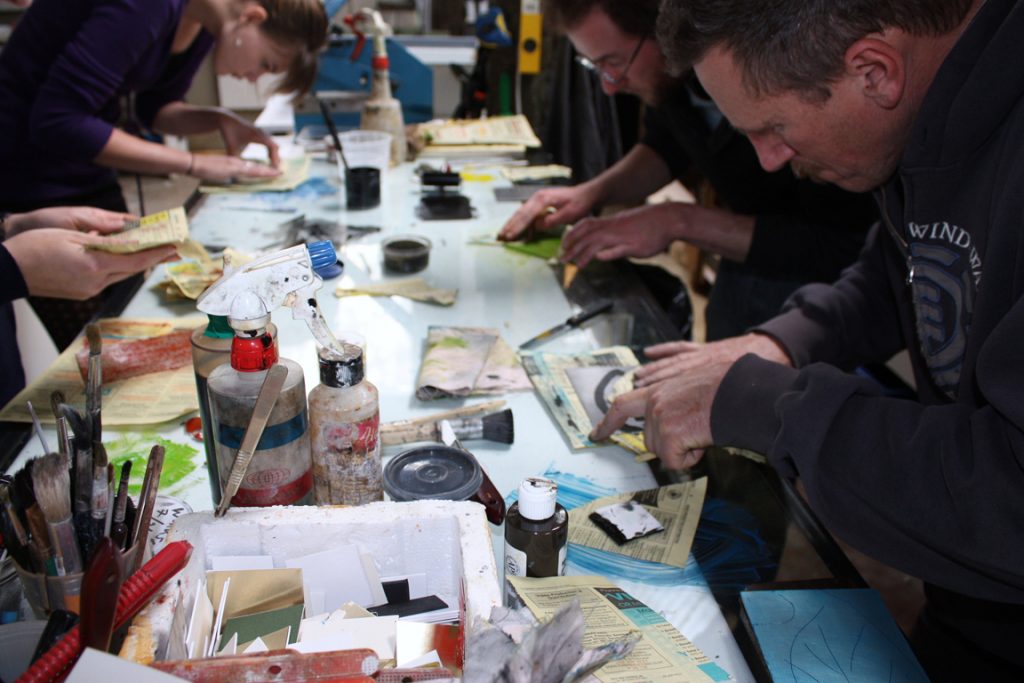
Another differential trait of feedback delivered by technicians in the workshop is the informal setting where it happens. It takes place in the studio, unannounced, unexpected, whilst the work is happening with the immediate possibility to adjust, and act upon it. This approach helps bend hierarchical assumptions: we are all practitioners trying to make work. It values work as an ongoing processes rather than a final outcome.
Contemplative pedagogy
As technicians, we have the benefit of seeing in situ the evolution of their work. Personally, the feedback I give is never a categoric right-wrong, success-failure, but rather a series of ideas that are food for thought. This nonjudgemental attitude cultivates what Wilson called “contemplative pedagogy” (2021, p53). This approach creates the conditions for “students to pause, reflect, and choose their responses”(ibid) as well as promoting self-evaluation. I like confronting them with questions such as:
“what is it that you like / don’t like from this print?”,
“what do you think is not working?”
“is this the right format for this image / idea?”
“why do you want to use this process?”
Using the workshop as a space not only to make, but to think, is “transformative, liberatory, and subversive” (2021, p.54). As practitioners, we should make more space for these discussions to happen and feel confident to express feedback holistically.
References
Orr, Susan & Bloxham, Sue. (2012). Making judgements about students making work: Lecturers’ assessment practices in art and design. Arts and Humanities in Higher Education. p.242.
Sams, C (2016) Spark: UAL Creative Teaching and Learning Journal. How do art and design technicians conceive of their role in higher education? Vol 1 / Issue 2. pp. 62-69
Wilson, C. (2021). A contemplative pedagogy: The practice of presence when the present is overwhelming. Journal of Transformative Learning, 8(1), p.53–54
Leave a Reply