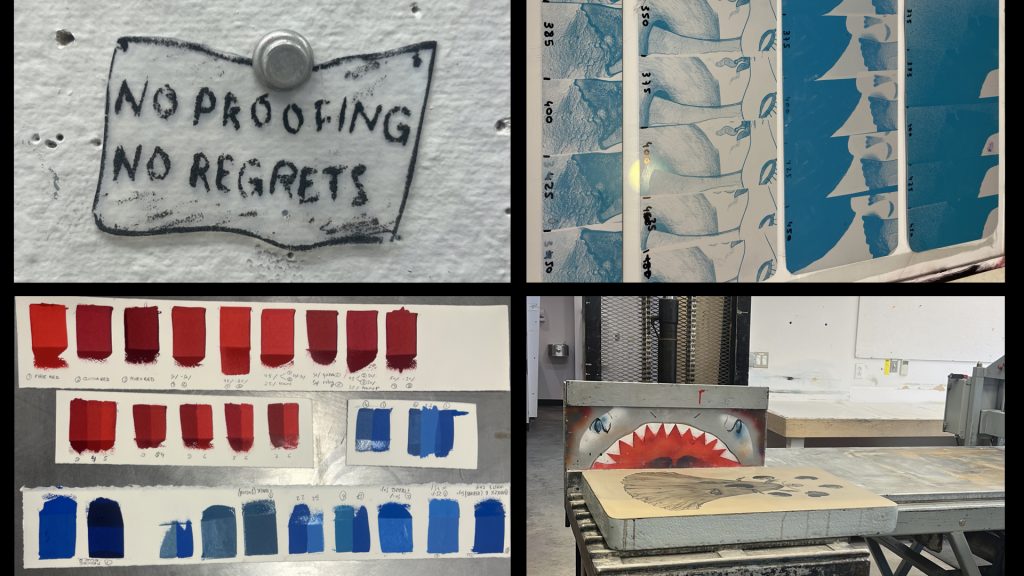
As a technician in printmaking, students often remind me ‘how lucky I must feel to have a job like this’ which indicates they perceive technicians as active creative practitioners. And, indeed, technicians are much more than specialist on a craft, often we are artist with a focus on a craft, however this aspect of the technician role is often not supported by the institutions we work for (Sams, 2016). In spite of HE institutions offering CPD (Continuous Professional Development), these funding programs seem to rather work as a perk of the job, than a successful effort to incorporate new skills, new processes or ways of working in the technical workshops.
Personally, I applied for CPD to fund my residency at Tamarind Insitute, University of New Mexico, US, an international leading institution for lithographers. My motivation was to refine the accessibility and efficiency of the lithography workshop at LCC, as well as comprehend the chemistry of the process in-depth to improve my teaching. This experience was an exceptional time for researching new ways approaches to stone lithography. I learnt, for instance, a technique called Maniere Noir, which consist in working on the lights from a black area. I even thought this could be an alternative to a traditional mezzotint, a much harder and time consuming technique.
Upon my return to work, the initial excitement was soon contrasted by the lack of interest from managers or an appropriate plan of action to incorporate these new skills to the workshop offer. Despite point number ten of the guideline for CPD funding warns us “Be prepared to present back on tangible outcomes from this development activity upon completion” (UAL, 2025), that was never requested. Not only that but also,
- There was no follow up of my experience: I was never asked to write a report or to have a meeting in this regard.
- There was no time programmed to share the knowledge among my peers. A missed chance to expand all team members’ skillset.
- There was no plan of action or scheduled research time to practice and adapt the new skills learnt to the university workshop. Testing and practicing is an essential stage before new techniques can get introduced to students.
If these actions were implemented after the CPD experience, the university would truly demonstrate their support and appreciation to and for their technical members of staff. Meanwhile, we will need to “maintain (our) arts practice in parallel to (our) technical role” (2016, p.63).
References
Sams, C., (2016) How do art and design technicians conceive of their role in higher education? Spark: UAL Creative Teaching and Learning Journal. London.
UAL, (2025) LCC CPD Funding Guidelines, accessed at https://canvas.arts.ac.uk/documents/sppreview/de91b60e-e94e-4bfc-8b12-9cffda7538de on January 20th, 2026.
Leave a Reply