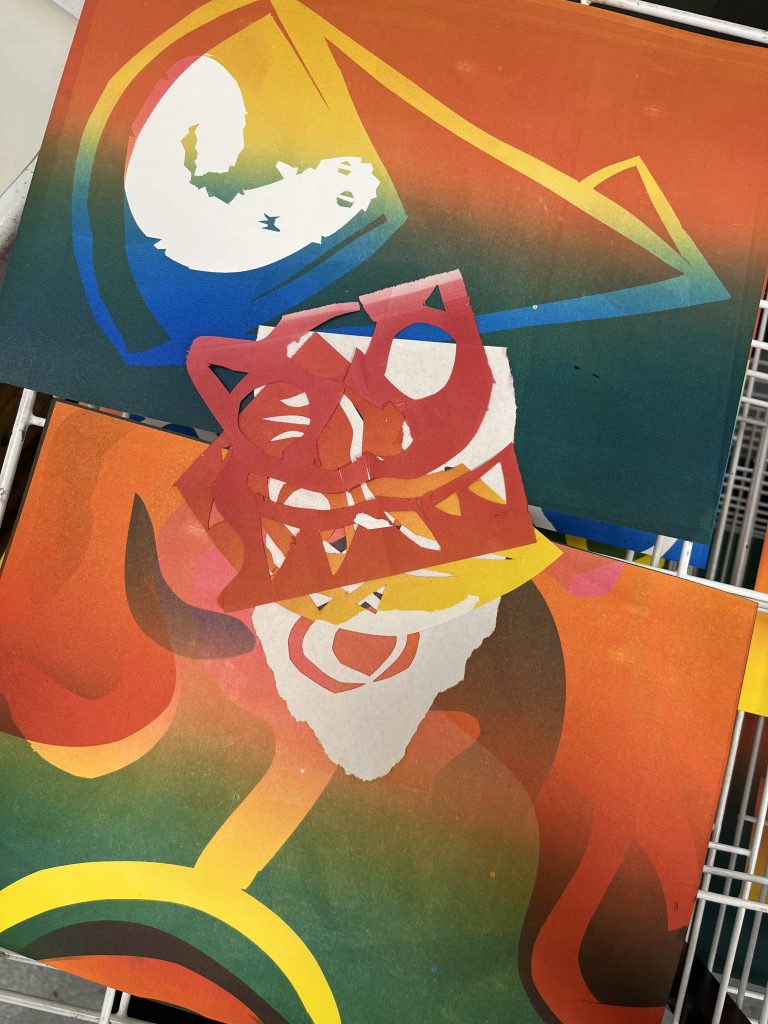
Session/artefact to be observed/reviewed: Monoprinting Induction
Size of student group: Approximately 6 to 10 students
Reviewee: Alba Gomez Urquia
Reviewer: Chelsie Coates
Part One
What is the context of this session/artefact within the curriculum?
Induction open to all students at LCC to gain access to booking a monoprinting workspace in open access in the Printmaking workshops.
How long have you been working with this group and in what capacity?
Some are students I’ve never worked with before, some might have come to the Printmaking Workshop but have never worked in monoprint before.
What are the intended or expected learning outcomes?
- General understanding of what is a monoprint and how they differ from limited editions prints
- Understanding of the different ways we can achieve monoprints
- How to ink up, compose, print and clean up following Health & Safety procedures.
What are the anticipated outputs (anything students will make/do)?
A series of monoprints using different processes (stencils, gelli plates and direct mono printing) and combining them.
Are there potential difficulties or specific areas of concern?
No, mono printing is an immediate and very intuitive way of printing. It uses low-tech equipment and, for most part of it, the ink is washable with soap and water.
How will students be informed of the observation/review?
In person, at the start of the session.
What would you particularly like feedback on?
- How appropriate/successful it is to show so many different processes in one same session.
- How the technical information is delivered
- Crowd control: whether there are better ways of managing groups of this size in such hectic sessions
- How effective is this induction for students looking to work independently on their coming sessions.
How will feedback be exchanged?
In person on the day and by email once the form is completed.
Part Two
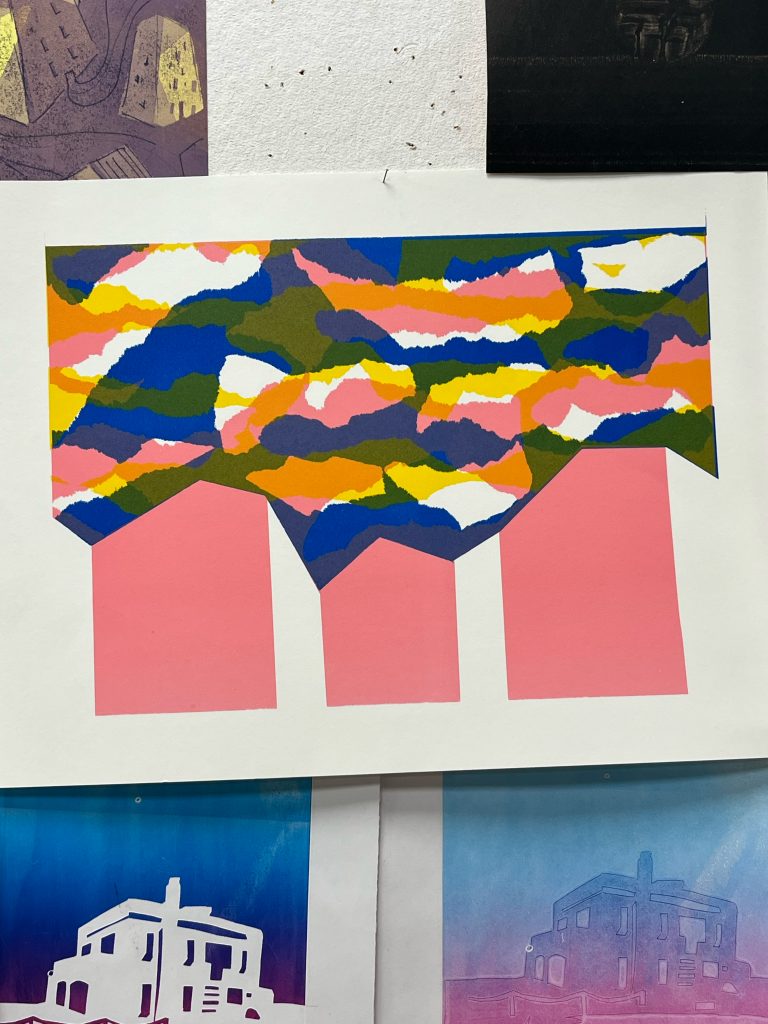
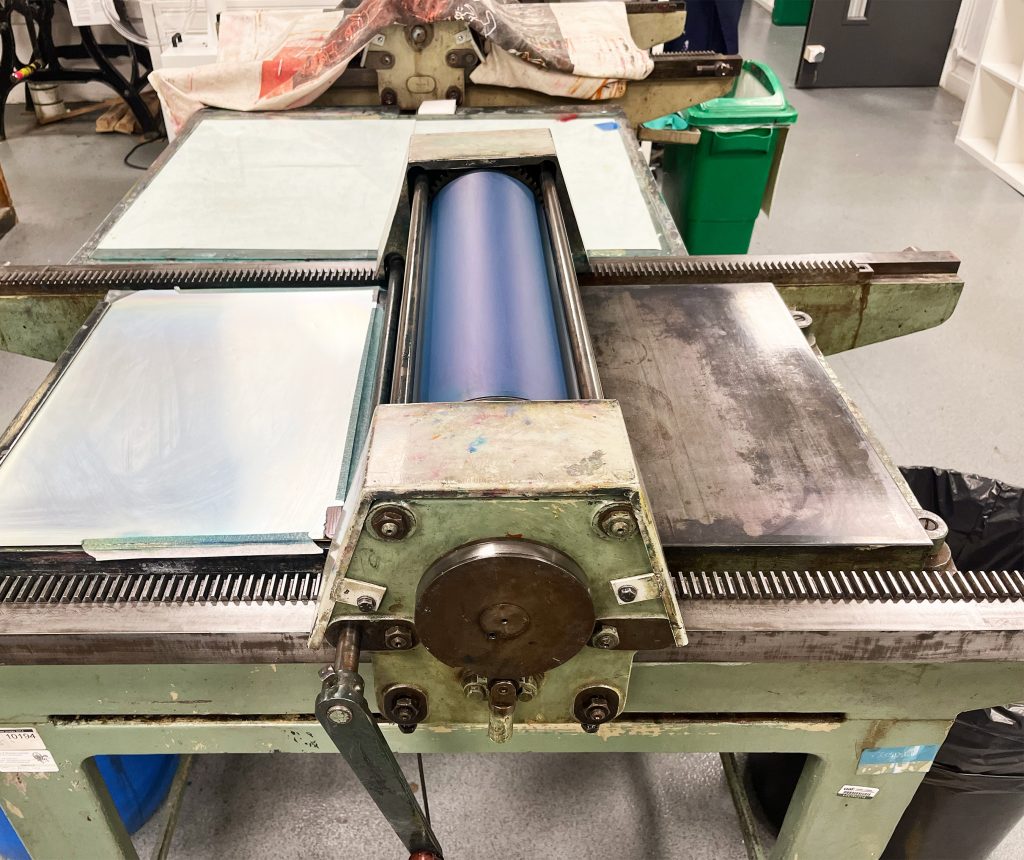
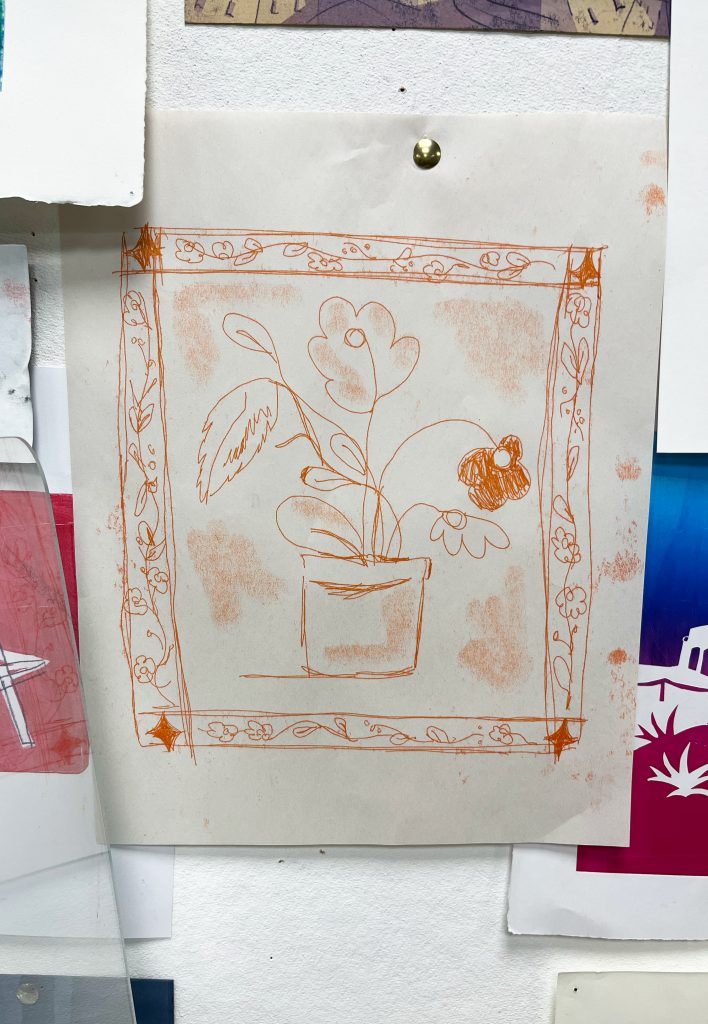
- Overall, induction was definite success, all students engaged in all 3 monoprint techniques during session. All students were heavily engaged & listening intently during demonstrations. None seemed distracted/ on phones apart to take videos of processes
- Opportunity to develop digital archive of processes in picture/video format so students can recap during independent working?
- Group of 6 was perfect for session. Meant 2+ students could be working on each process at any one time, without waiting to print. Organic movement around processes. Alba managed students well & was able to give verbal feedback & support to each one individually during the session.
- How would you ensure a larger group fully understands each process?
- Perhaps create a scheduled timeline for rotating groups of students on each process?
- Asking students if they have done other printmaking was good way to engage so they immediately draw on previous skill set. Mix of experience made for a diverse group of learners for Alba to manage.
- Letting students choose colours & pick imagery increased engagement & created higher reward process.
- Colour-theory during offset ink rolling engaged the students in the process of gradient. Good for future independent work.
- Using non-print metaphor was useful in the gradient rolling. Could this be utilised more to encourage retention?
- Use of the digital prompt regarding multiples/matrix info was good visual aid for students to understand difference with monoprint to other forms of print.
- Could prompts shown can be tailored more to the session itself, and signposting to access info after session?
- Preparation of direct monoprint inking done by staff – perhaps be done by students to engage more in that process and get practice with inking to support future access.
- Noted that due to time constraints with larger groups, may not be possible.
- Noted almost all students did ink up either during demos / gelli plates, but larger group might not have enough capacity for everyone to try.
- Students struggled with inking gelli plates correctly. Focus on process? E.g. before moving to offset, students pair up (pairs might be less pressure than on own) & ink gelli plate together, whilst teacher checks? Might also be implemented with other processes to ensure every student has had go at inking all methods correctly?
- Drawing attention to student examples on wall encouraged making & creativity + opening possibilities of monoprint. Exciting examples on wall & students asking how to emulate look of many of these.
- Would it be useful to have a physical archive of examples of each specific process so they can really understand the differences between each/ possible mark-making & reference easily?
- Great do’s & don’ts on technique given + opportunity for experimentation & development. Showing outcome of what not to do during each process was useful retention tool.
- Using multiple mark-making techniques, tools & materials gave students a solid understanding of range of possibilities available to them & sparked excitement.
- During gelli printing, there was reference the different type of ink used in each process.
- Is it worth extrapolating on why certain inks for each process & benefits of water-washable inks? May reduce mistakes for future access.
- Asking for volunteers during demos was good use of student-led learning. Verbal encouragement given to volunteers boosted confidence & made more comfortable.
- What might you do in a situation with no volunteers?
- Counting: useful tool introduced for printmaking.
- To encourage retention, can everyone count out loud together?
- Discussing use of monoprint as digitised artworks used in animation etc. was good inspiration.
- Digital examples could be useful!
- Offset seemed harder for students to grasp, with use of machinery & stencils not going to plan.
- Is it worth thinking about offset becoming a workshop within its own right, OR developing an advanced offset workshop to build on introductory one?
- Opportunity to return after lunch was great way to let students further develop the processes and feel more comfortable.
- Doors being open to rest of workshop with music during could be distracting to some students e.g. neurodivergent.
- Can doors be closed during talking/demo & reopened when making begins?
Part Three
1) Physical and Digital archive of examples
I believe it will be beneficial to have examples laid out on the table to introduce each process in addition to those hanging on the wall, however it’s hard to find time to make them. The ones we have are mainly prints by students and then don’t always want to leave good prints behind for us. Expanding our collection of examples and digitalise them is a priority. Perhaps these examples could be available on Moodle for reference.
I think making a pool of examples of how mono print is implemented in other formats such as animations, publications, backdrops… is a wonderful idea. Perhaps we can ask students to share their projects to use as inspiring examples.
2) Managing a larger group
It was suggested to use a timed rotation system when inducting larger groups to make sure everyone gets a taste of all the different processes. I think that’s a clever solution specially timing it.
3) Introducing colour theory
We also run a specific induction on colour theory, but I like to bring up this set of skills when working across processes for it’s an important part of the design process and a crucial factor when working with actual inks. This kind of skills are transferable among processes and I want them to consider that when facing new methods.
4) Laying out inks
It was suggested to let students set up the inks, and whilst that is a good point, I like setting up to keep the working space defined. My previous experience letting big groups set up by themselves makes the space messier than it needs to be. Giving them some constraints is like giving them a framework to work on this new process.
5) Explaining Why
It was noted that lots of my explanations answer WHY we do and don’t do things rather than WHAT and HOW. I believe that’s important because if students know the reasons behind, that makes every step easier to remember.
6) Volunteers
I like to make my inductions as participant as I can. I like to take in inputs from students and make it an enjoyable experience rather than just delivering knowledge. It contributes to create a sense of belonging and hopefully invite them to come back.
7) Doors
Because of the nature of the workspace, doors are usually open to allow easy flow of students, but I agree that explanations and demos could be done with the doors closed to avoid interruptions and create a focused environment.
Leave a Reply