Reviewee: Alba Gomez Urquia
Reviewer: Linda Aloysius
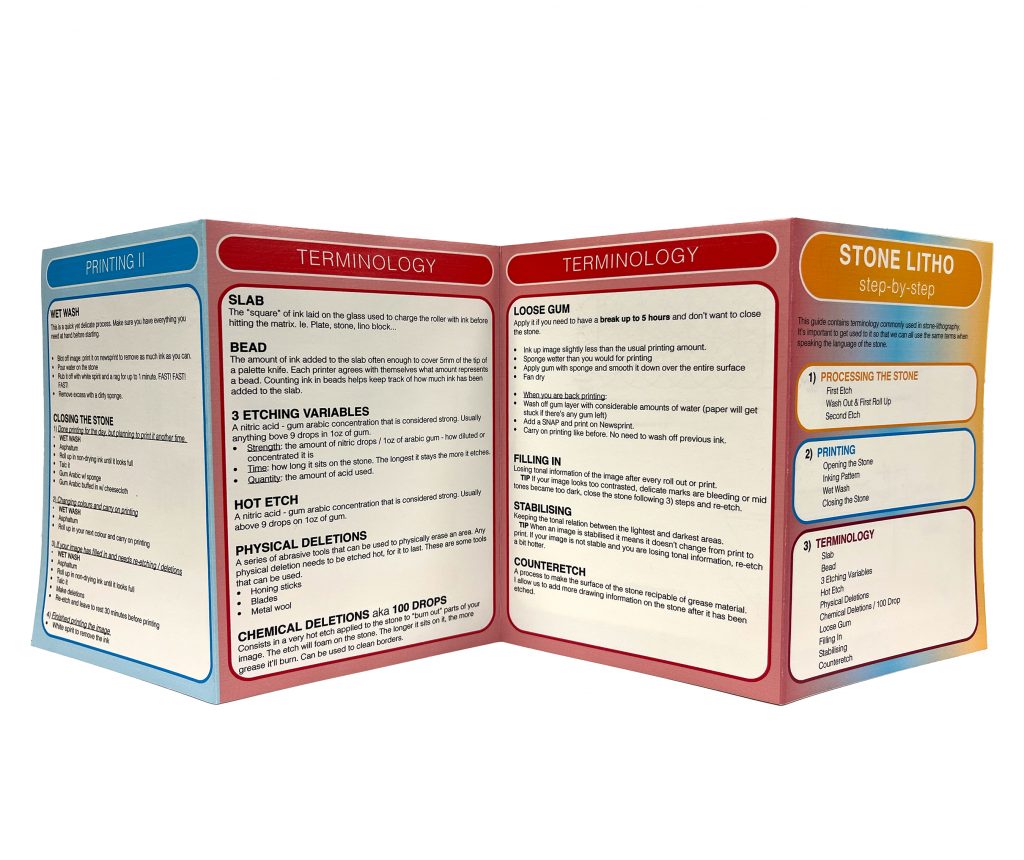
Artefact to be observed/reviewed: Lithography handout / step-by-step guide.
Part One
What is the context of this session/artefact within the curriculum?
The printmaking workshops at LCC are open to students of all levels and courses, and offer about 15 different printing processes. One of the most challenging ones is Stone Lithography because it is a chemical process that entails lots of different steps, it’s hard to remember and easy to get the steps mixed up. This step by step handout is given to students after they pass their induction so that it can be used to remember all the steps and allow them to work independently.
How long have you been working with this group and in what capacity?
I never work with the same group of students. We get some regular students working across processes.
What are the intended or expected learning outcomes?
– Prepare the student to work independently in stone lithography from processing to printing
– Recognise and use terminology specific to this process.
What are the anticipated outputs (anything students will make/do)?
This handout hopefully builds up their confidence and increases the number of students coming back to work on this seemingly daunting process.
Are there potential difficulties or specific areas of concern?
Printing – we don’t do enough printing in the induction given the time limitations and how long it takes to prep the stone. They also work as a group during the induction, so hopefully having a step-by-step guide pumps their confidence when printing and removes a little of bit that daunting feeling of working with a stone by themselves.
How will students be informed of the observation/review?
They don’t need to be informed, as the reviewer will comment on the suitability of the handout and not student turn-up.
What would you particularly like feedback on?
- Is it clearly presented or confusing and hard to follow?
- Is the information is well structured given the complexity of the process?
- Is it a good guide for those who have been previously inducted?
- Would you dare to try for yourself?
- Would you feel supported by this handout?
How will feedback be exchanged?
By email or video call.
Part Two
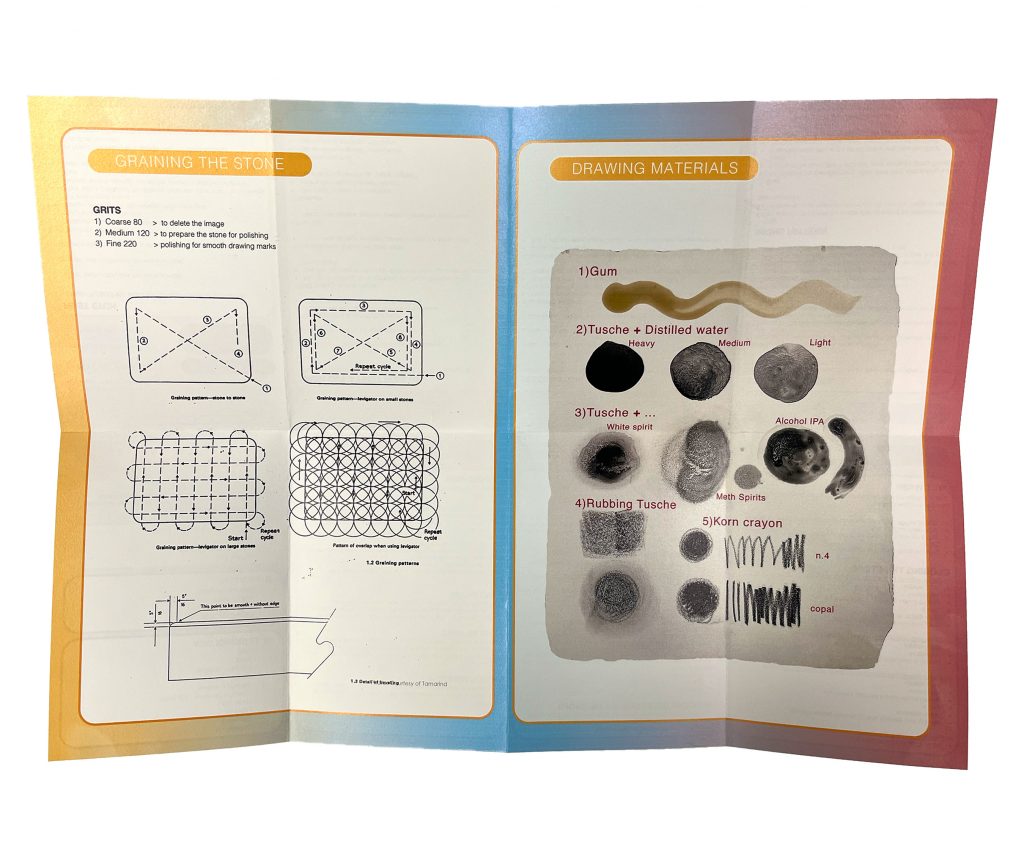
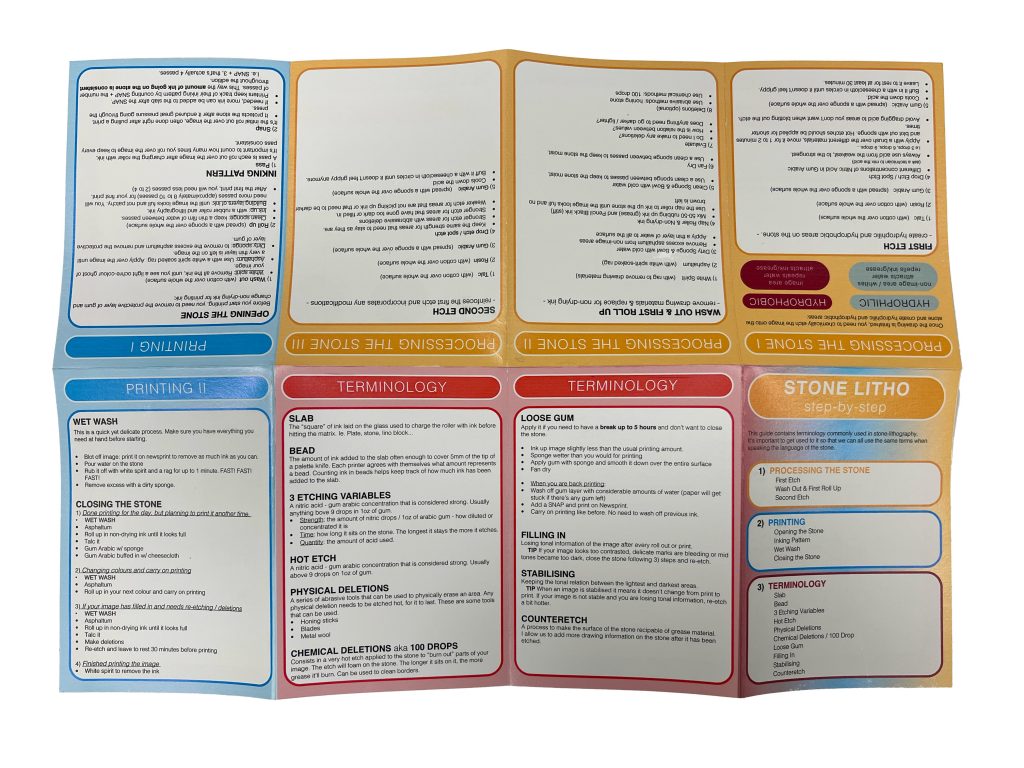
Thank you, Alba, for sharing your teaching practice materials with me. It was a pleasure to meet with you and discuss this and your ideas. Overall, and as I commented in our recorded meeting, I thought the booklet you created was a fantastic asset for your students and a great contribution from you for your department. You have obviously spent a lot of time and applied your expertise to create such a helpful resource.
In our meeting, some of the key points we covered included:
- We noted that having a written document with specialist terms and languages will be of great benefit to the students, particularly students for whom English is not a first language.
- We discussed possibly adding graphics; you had already explained you intended to add graphics to the reverse of the fold out booklet, which I think is a great idea though there is possibly scope to add some on the ‘front’ side of the booklet too.
- You asked me my opinion about the colours you have used – I thought they were fine and not too complex for the students, with the blue, orange and maroon quite clearly being used to guide students through different aspects of their learning. After I left the meeting, it did occur to me that I have seen instances before not of booklets but of slide presentations – where tutors have decided to use the UAL colours of Black, Pink and White / use UAL formatting for powerpoint presentations. It did occur to me that an option could be to use UAL colours, though that would perhaps make the booklet seem much more like the property of UAL and might detract from the originality you have brought to it.
- It also occurred to me later, after our meeting, that there is the option to make the booklet slightly more interactive, perhaps by including things like step-by-step checklists, so that students can feel that they are working their way through the book, almost like a mini ‘manual’. This is, however, entirely optional – I don’t think it would be better or worse than what you have already created.
- I encouraged you to find ways to take credit for your work; we briefly acknowledged that it is not always easy to do this and also that credit is not always given when it should be. Nevertheless, you could for example copyright it in your name and perhaps offer it as a prototype for other departments and courses to borrow from – maybe this is something to discuss with your Line Manager at an appropriate time?
- Without wanting to pressure you I encouraged you to consider extending the booklet to become an actual book for publication; you mentioned that you had considered studying for a PhD, which of course is great. However, I’d encourage you to consider that things like conference papers, journal articles, and books (!) do not need for the author to always have a PhD. I hope this did not pressure you in any way – obviously you have enough work to do already! But the subject matter and the approach you take could make this a possible project for the future.
Part Three
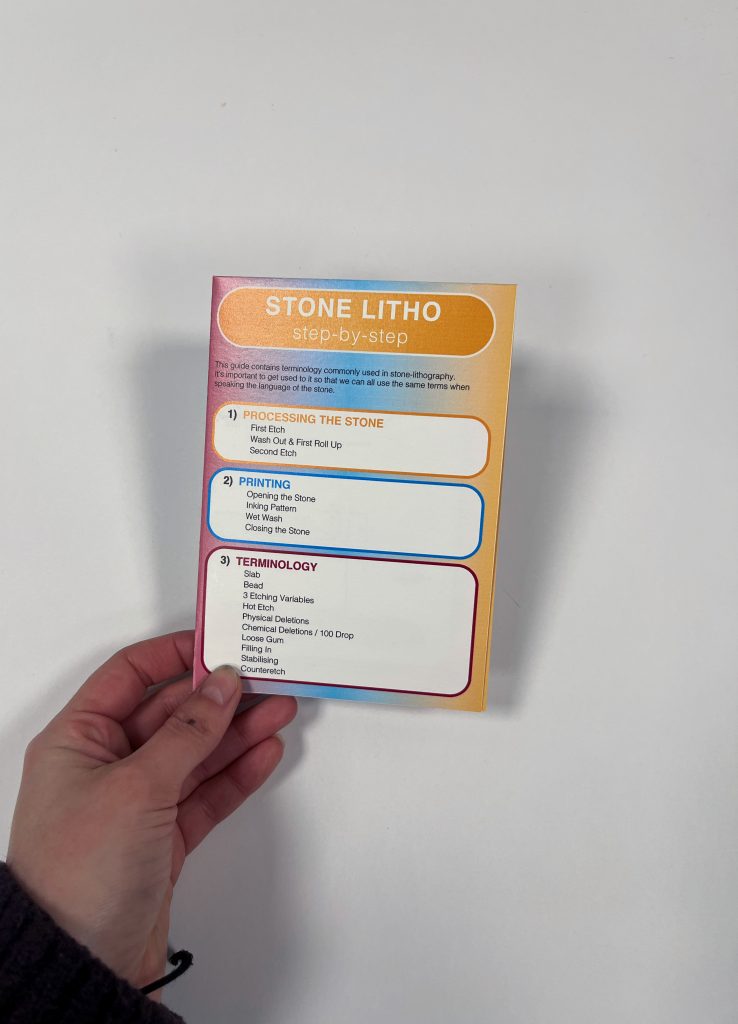
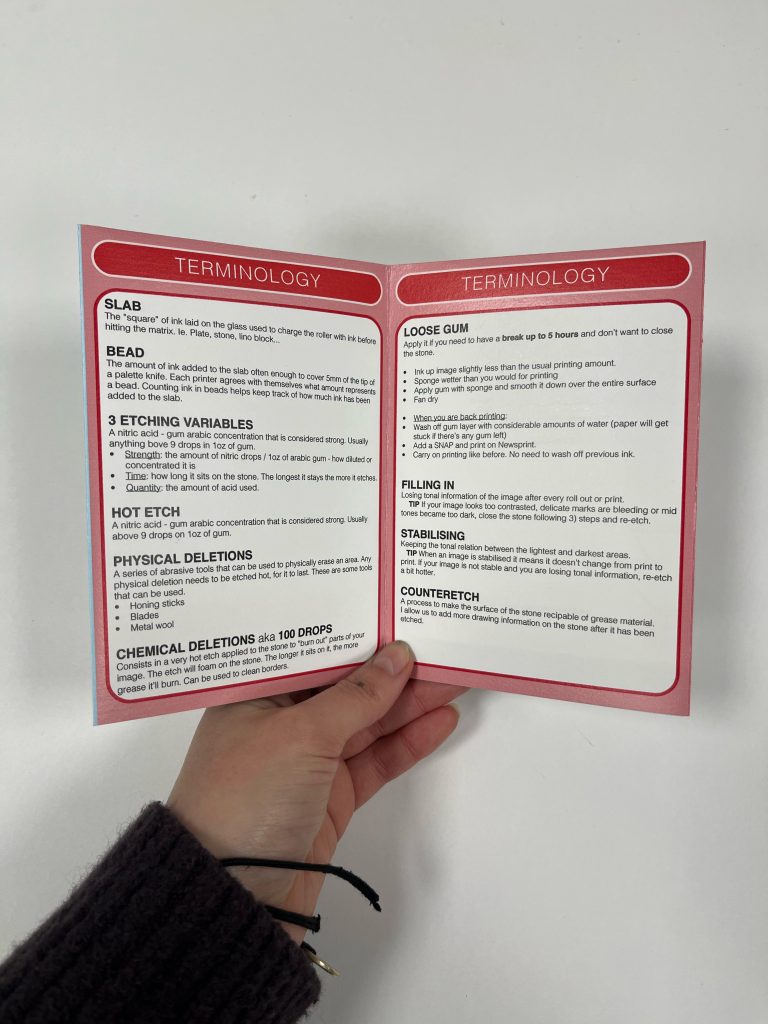
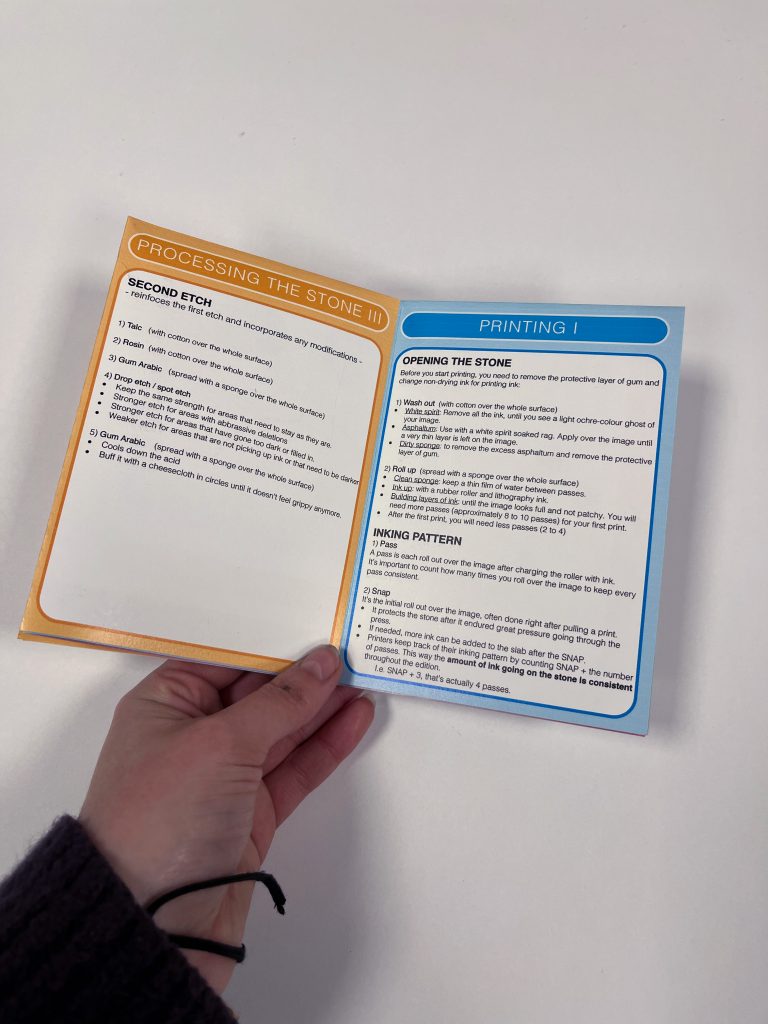
- After receiving feedback during our meeting and reading Linda’s notes, I have printed out another version of the handout which includes graphics on how to grind a stone and examples of different drawing materials as they look on the stone.
- I understand the idea of making the booklet more interactive, but stone lithography is not a one way process, so having a checklist wouldn’t necessarily suit the manual. In lithography you go back and forth, with some steps needing to be repeated sometimes, and other steps, not even necessary in some occasions.
- I love the idea of using this artefact as the excuse for writing a longer, more detailed piece. However, making a publication on stone lithography seems a bit irrelevant as there’s several books that compile all that technical knowledge such as the all-time favourite ‘Tamarind’s Book of Lithography’ -known by every lithographer as “the Bible”-, or more recently, Lemonade Press, based in Bristol, has also published their take on it. Perhaps I could write an article on how to teach lithography in our fast-paced times. There’s this printmakers’ magazine called Pressing Matters which is always open to receiving new article ideas.
- Publishing my ideas on how to teach this process can be a good way of getting credit for the work and hours put into it.
Leave a Reply